Wednesday, March 5, 2014
Catching Fire
Catching Fire, by Suzanne Collins, takes off where The Hunger Games ended. It takes us through Katniss' journey into her new reality of stardom and wealth, and then directly back into the terror of the Hunger Games. This book explores a whole new set of questions while still reminding the reader to keep the old questions in mind.
In Catching Fire, the Hunger Game contestants are chosen from the past winners from each district. One of the selected contestants was an elderly woman, Mags. It is clear that Mags had had a stroke previously, and that she suffered from expressive aphasia (difficulty speaking). She volunteers when a young woman with small children was originally chosen. It is clear that Mags is giving her life to save someone else, and before the end she is able to save another life. It never crosses anyone's mind that the extremely elderly or disabled, should be excluded. I guess this shouldn't have surprised me since the teenager's lives are so meaningless to the government and people of the Capitol.
As a person who works with the elderly for a living, I had no problem picturing Mags. I picture a little elderly woman. Hunched from osteoporosis (as it seems many older people are) and off balance because of some lingering left side weakness. Walking almost like she is going to tip forward head over heals. I picture some of my patient who are supposed to use walkers, but tend to forget. As a person who works so hard to give people with these afflictions dignity, it struck me how different character treated Mags.
Everyone looked at Mags with pity. That seemed to be universal. Everyone knew that she would be one of the first to die if no one helped her. She was the mentor of Fennik, the other contestant from her district, and his attachment to her is what saved her life at first. He protects her, and literally carries her when she is unable to keep walking. At first, this is what Katniss sees in her too. A courageous, elderly volunteer who is dear to Fennik. Mags is able to prove her worth to her competitors/ companions through her knowledge, helping find a source of fresh water. As much as Katness, Peeta, and Fennik try to protect her, I think that they are all a little bit happy that Mags died when, and the way that she did. None of them wanted to be forced to make the decision of killing her, or dieing themselves. I will admit that I am glad the Mags died with dignity and honor (I don't know how to say this without it sounding like an epic battle for Camelot).
Catching Fire also brings to light the horrible treatment of the winners which lies just below the celebrity and wealth. We learn that the winners of the games are not only forced into interviews and appearances (which is expected), but also, forced to do whatever the government wants by way of threats to their families. One of this book's main characters was sexually exploited for the gain of he capitol when threatened with the death of his family and girlfriend. I don't think that any one would argue against me when I say that forcing prostitution is wrong, but this does lead to questions on more minor things. When does our treatment of celebrities go to far? Paparazzi on the street? Fans flocking to places where the they have been spotted? Going up to them for autographs when they are not at an event? In the Hunger games universe it is different because the contestants are forced into celebrity, but this is something to think about.
Unlike the first book in the series, this book ends with a clear cliff hanger. There has to be another book because the world has basically fallen apart around Katness. She doesn't really know where she is, if she is with friends or foe, why she is there, where Peeta (and everyone else) is...If I had read this book before the sequel had been out, I would have been anxiously awaiting it. As far as book reviews go, that is a pretty telling sentence.
Monday, January 27, 2014
The Hunger Games
It took me a shocking amount of time to get around to reading The Hunger Games, by Suzanne Collins. It came out in 2008 while I was entering university. I certainly heard about it, but if I was doing any reading for fun, it was my old favorites, not anything new.
About the time that the film adaptation was coming out in 2012, my brother told me that this was a book that I HAD to read. I then knew that I would enjoy it. This was the brother who had, in the past ten years, basically only read Harry Potter and The Lord of the Rings. Like me, sticking with two favorite series. Yet, I had a few books on my reading list which I already had on my shelf. It didn't make sense to buy another book just to have it sit on my shelf.
One day last spring I found it in the book section of Value Village and grabbed it up for $2.99. It then sat on my shelf until November.
I read the first couple of chapters in early November, and I did enjoy the read. Unfortunately, I started reading it on a couple of night shifts and was never really able to get into the "reading zone". I would read a couple of pages and a call bell would go off. The book didn't make it out of my bag once I got home, and unfortunately November had a record low number of shifts for me, so it wasn't until mid December that I picked it up again.
I decided to start at the beginning, and I am glad that I did. By the end of my four days off I was half way done the book, and had picked up the next one. By the end of my next days off I was part way through the sequel, and by New years I had finished the Trilogy.
I haven't had a set of books hook me like that since Harry Potter.
This book really makes a person think without forcing it. Above all it is a story, but it makes the reader question their own morals and knowledge quite a bit. How far is too far? Where is the reality to line crossed? How much control is too much for the government? How much do we really know about how to world works? What is the line between self defense, murder, war, assassinations...? Could YOU really kill someone if put in the kill or be killed situation? Is it better to die than to live with killing something?
The reader doesn't necessarily realize that they are asking these questions, but when one judges the character's choices, and learns about that world, the reader does in fact start to think about these things. I think that these questions are important to think about. I don't really think that many of us will be put in this sort of situation, but when you replace killing with breaking the spirit, ignoring, bullying, or looking down upon, the same message comes across. Is is ok to put down others in order to make yourself look better to your boss? To get someone fired in order to get a raise?
All of this from a young adult novel about teenagers being forced by a corrupt government, to kill each other on tv.
Sunday, December 29, 2013
Shadow of Night
Shadow of Night by Deborah Harkness is past two of the All Souls Trilogy (part one being The Discovery of Witches. While this book is clearly in the middle of a larger storyline, it clearly takes on different issues than the previous book.
This series is based around the search for a book, and the three missing pages from it. A very important, enchanted, book which contains currently unknown information about the genesis of the supernatural beings: witches, demons, and vampires.
Shadow of Night continues to follow the story of Diana Bishop, a witch just discovering her powers, and her partner/husband/ significant other, the vampire Mathew Clairmont. Unlike the previous book, this one is set in Elizabethan England. Yes, this does make sense in the book. While the last book took place in what can be thought of as Diana Bishop's home turf, this one is clearly in Mathew Clairmont's.
As a vampire, Mathew already lived through this era. In fact, some of his friends are major and minor characters. They are able to spend some time with his "father" who died during The Second World War. Diana is able to work on Alchemy (which she studies and teaches in modern times) with a famous female alchemist (who I hadn't heard of, but seems to have been quite important). Being in the different time period give Diana a chance to find someone to teacher her how to use her developing powers.
The discovery of Diana's powers. Diana has always known that she is a witch. Her family have always been witches. However, Diana stopped using her witchcraft (in which she was not proficient in the first place), as a child or teenager, shortly after her parents died. She and Mathew are now under scrutiny, and in physical danger because of their relationship. Thus, they must travel back in time (using her newly discovered genetic time-walking power) to a time when they are not being hunted. Unfortunately, some unpleasant parts of Mathew's past are now in the present, and by the end they are forced to return to the tremulous present day.
Monday, November 4, 2013
The Kitchen Daughter
The Kitchen Daughter by Jael McHenry struck a bit of a cord with me. I follow many blogs about parents of children with disabilities. I know people on the autism spectrum. It was refreshing to read a book in which the main character had these tendencies, yet disability awareness wasn't the main point of the book.
I enjoyed the way that each chapter began with a recipe which was used as foreshadowing for the chapter. I found it interesting to immerse myself into the character's thoughts and feelings while she cooked. Reading how she was so passionate about her cooking and recipes was refreshing. For me, the aspect of the book around her seeing the spirits of the people who are connected to the recipes, and solving a family mystery took a backseat to the struggles for independence and finding her place in her newly divided family. .
This book was wonderfully realistic showing of the main character's desire to be self sufficient and independent after the death of her parents. Her sister believes that she is incapable of living independently and this is a bone of contention between the two sisters. While I spent the entire book rooting for the main character, but by the end I was not so sure.
Sunday, September 22, 2013
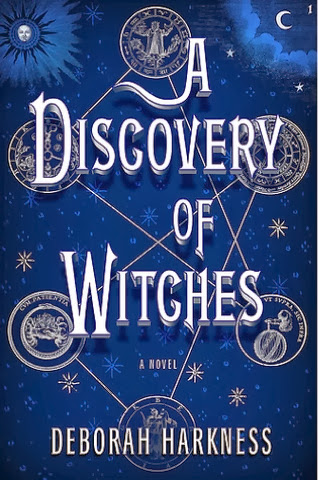
A Discovery of Witches
This book came to work with me on nights, but never left my bag. I was either busy, or my eyes just couldn't focus on a book at 0230. This book also had the unfortunate disadvantage of coming to me just as I discovered the joys of Netflix.
Then I started to read again. Over the course of October I read this book, and it's sequel, Shadow of Night.
I found A Discovery of Witches to be a well written, and quite a well thought out book. It brings a large number of well known (and most likely a fair number of not so well known, who I didn't recognize) people into the story line which certainly adds a level of interest. I am not typically one for vampires, but having the immortal element is a nice way to show history to the reader
At first glance, this is a book about witches, vampires, and demons, but one doesn't have to look very hard in order to become enthralled in the politics in the natural world, the supernatural world, and the interactions between the two.
I also enjoyed the science/ scholarly aspect being brought into the story. The two main characters both work at a university studying and teaching, one alchemy, and the other genetics. This brings about a deeper aspect to the storyline than I expected from this book when I first picked it up.
This is book one of the All Souls Trilogy, two of which are out and I have read. I don't know when the third will be out, but I am looking forward to reading it. It is nice to have series, and a book to look forward to, instead of finding them all once they are all out. I think that the anticipation will make the third book even better.
Saturday, August 10, 2013
My Mother's Secret
The story shows the bravery of this mother and daughter as they attempt to hide and support whomever came to them. They go to great lengths to protect those who they hardly know simply because it is the right thing to do.
When I think about what i would do in their place, I would like to think that I would do the same thing. I would like to think that anyone would do this, but if everyone did, it wouldn't be so amazing and awe inspiring.
Monday, July 1, 2013
Mercy Train
Mercy Train is an interesting book which follows the stories of three generations of women, each at a pivotal point in their life. One is a young girl leaving everything that she knows, one and elderly woman facing death, and one a young woman facing life after becoming a mother. .
Timeline wise, the eldest of the main characters is a young girl, growing up in poverty on the streets of New York in the early 1900s. This is the character is the one which the title most literally refers.
Her daughter's story takes place when she,the daughter, is an elderly woman coming to the end of her battle with cancer.
The story of the third generation follows a new mother who is given a box of trinkets that had belonged to her mother. As she goes through them, she tries to piece together the stories of her Mother and Grandmother.
I found this book to be an interesting and easy read. I have found myself enjoying historical fiction more than science fiction now, which surprises me. Looking back I see that I enjoyed reading historical fiction for school, but I always thought of it as school reading, not leisure reading. I don't necessarily think that my interests have changed, just that I take a less direct route the the science fictions section of the bookstore.
Subscribe to:
Posts (Atom)