Showing posts with label young adult fiction. Show all posts
Wednesday, April 1, 2015
Divergent Trilogy
Divergent, Insurgent, and Allegiant are a trilogy of young adult books written by Veronica Roth. It would be quite difficult to write about the second and third books without giving away the entire plot, so I will tackle them all mostly as one. The story takes place in a sort of post-apocalyptic, dystopian city in which the people are sorted into five factions based on strengths, weaknesses, values, and personality.
Abnegation, for the selfless
Amity, for the peaceful
Candor, for the honest
Dauntless, for the brave
Erudite, for the intellectual.
The people from each group coexist, but don't seem to interact regularly, especially after the age of 16 when they choose their faction. There is a sense of underlying tension between the factions in the beginning, which comes more into light as the series progresses. The various factions use their own means to gain or keep power. This all comes to a head just as our main character Tris comes of age, and begins to learn the inner workings of the city.
Divergent begins with the lead up to Beatrice (Tris) Prior's choosing ceremony where she must decide which faction to be in for the rest of her life. She doesn't feel that she completely fits into any of the factions.This idea of fitting into more than one faction is in fact key in the whole series.
I can see how this concept of choosing one's life path speaks so much to the book's young adult audience. When one is 16, sometimes even the act of picking the right seat in the classroom, or hanging out with the right people can seem like it will make or break one's life. This book manages to both validate the impact of these decisions, and show that there are bigger things in life.
As with most books in the YA genre, romance does play a large role in this series, although the author does keep the romance from taking over the plot. Tris does have a love interest, and while the series does chronicle their ups and downs, the books never stray far from the action packed revolution.
Another of the main themes throughout Divergent is the questioning of authority. The idea that adults, and especially government officials, are not always trustworthy, is prevalent in the YA genre. Tris has to question all levels of authority including her parents, teachers, faction, government, and all those beyond her known city. Tris has to uncover who is lying, and more importantly, their reasons for lying. Basically everyone in the series seems to be a traitor against someone or something.
Conversely, loyalty and sacrifice are also a strong theme. Not only do characters sacrifice themselves for each other, or the greater good, but the books also bring up deeper moral questions surrounding asking and requiring sacrifice. Asking another person to sacrifice them self for others. Picking someone to be sacrificed. These questions don't have right answers, and the books do not particularly lead the reader to lean one way or another on any of these issues. The series simply brings them up, and creates a way for the reader to ponder these dilemmas.
I recently heard an interesting point of view on a podcast. One of the hosts talked about how many of us who grew up in the years around 2000 became attached to the Harry Potter series, which is about keeping a world which is good from becoming evil. Those children/teens who grew up/are growing up in the more recent years, tend toward the books which center around rebuilding society. Changing the world from bad to good. This makes sense when you think about the situations going on around the world at the time.
The 90s were pretty good, but there were rumblings of crisis, which broke out in the early/mid 2000s. It makes sense that people growing up at this time would be able to connect with stories in which people are fighting to keep the world good. In the last decade or so, there has been all out war, increased crime, harsh economies, and an increased coverage of government wrong- doings. It makes sense that kids/teen growing up at this time would gravitate towards books which focus on wiping the slate clean, and creating a good society (ie, Hunger Games and Divergent). This makes me wonder what themes will be popular ten years from now. Still crisis? Rebuilding?
Labels:
books,
Divergent,
reading,
YA,
young adult fiction
Tuesday, June 3, 2014
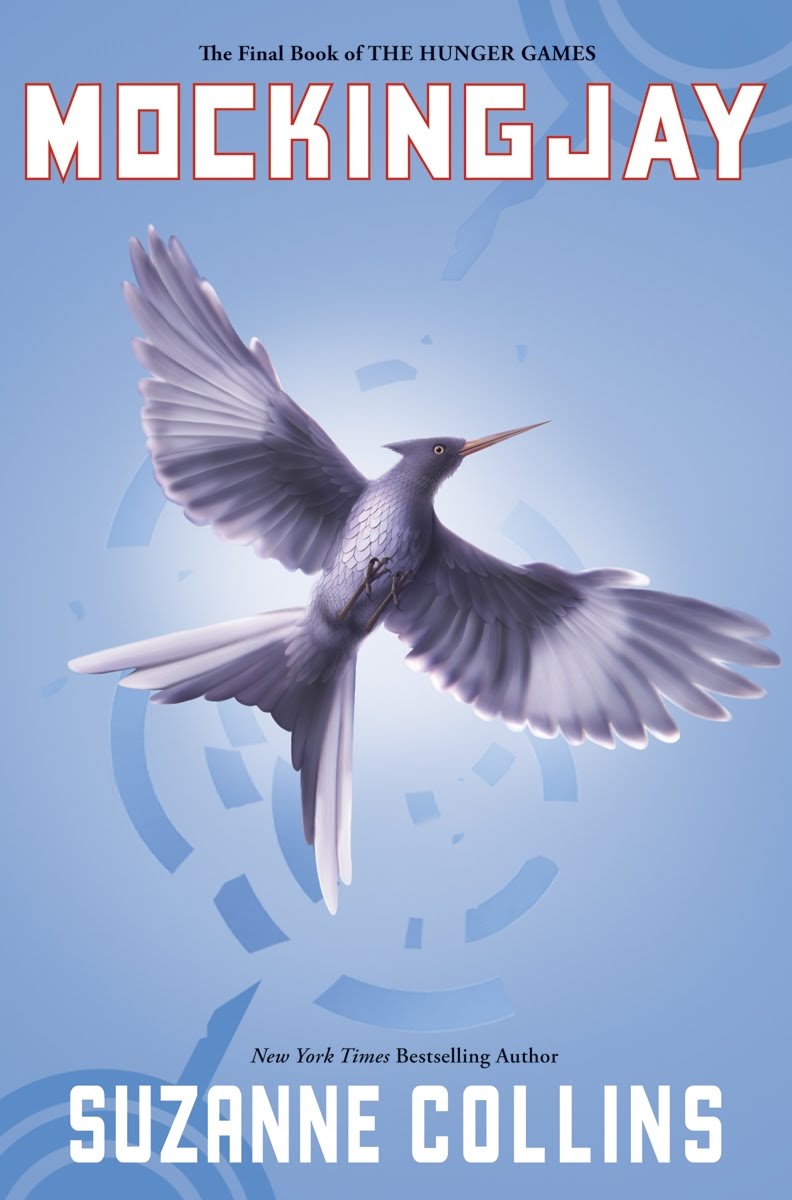
Mockingjay
Mockingjay, by Suzanne Collins, is the third and final installment of The Hunger Games trilogy. It included many of the same themes, and issues as the previous books. That being said, this book is quite different from the others in storyline. While the other two books are centered around the Hunger Games competition, this book is firmly set in the midst of a rebellion against the government.
As with many books in the young adult category, the Hunger Games Trilogy is quite anti-government. The government, and the citizens living in the Capitol are wealthy elitists. The people living in the twelve districts are pushed down, working (farming,mining, logging...), without the hope of bettering their lives. There is mention of a large rebellion many years previous in which the districts rose up against the Capitol. After the rebellion was crushed by the Capitol, the Hunger Games were started as a way to remind the people of the Capitol's complete control.
In this book we find out about the 13th district. This area had been completely destroyed in the rebellion, and it was believed to be uninhabitable. It turns our that there is a large military complex hidden there (I picture an area like NORAD, inside a mountain, only this is unmarked). The rebellion which was just under the service in the previous books is the key storyline in this book. This book looks at how issues which originally look black and white, are rarely that way once you dig into them, as the leaders of the rebellion make questionable decisions. Katness becomes the poster-child of the rebellion, and has to live with this even as the higher powers make decisions which she struggles with.
The book also includes the ever present love triangle, Katness' family, and Peeta's eventual PTSD. This book brings up the question of how much can be sacrificed for the greater good? Who gets to decided who lives and dies? When is rebellion really revenge?
Monday, January 27, 2014
The Hunger Games
It took me a shocking amount of time to get around to reading The Hunger Games, by Suzanne Collins. It came out in 2008 while I was entering university. I certainly heard about it, but if I was doing any reading for fun, it was my old favorites, not anything new.
About the time that the film adaptation was coming out in 2012, my brother told me that this was a book that I HAD to read. I then knew that I would enjoy it. This was the brother who had, in the past ten years, basically only read Harry Potter and The Lord of the Rings. Like me, sticking with two favorite series. Yet, I had a few books on my reading list which I already had on my shelf. It didn't make sense to buy another book just to have it sit on my shelf.
One day last spring I found it in the book section of Value Village and grabbed it up for $2.99. It then sat on my shelf until November.
I read the first couple of chapters in early November, and I did enjoy the read. Unfortunately, I started reading it on a couple of night shifts and was never really able to get into the "reading zone". I would read a couple of pages and a call bell would go off. The book didn't make it out of my bag once I got home, and unfortunately November had a record low number of shifts for me, so it wasn't until mid December that I picked it up again.
I decided to start at the beginning, and I am glad that I did. By the end of my four days off I was half way done the book, and had picked up the next one. By the end of my next days off I was part way through the sequel, and by New years I had finished the Trilogy.
I haven't had a set of books hook me like that since Harry Potter.
This book really makes a person think without forcing it. Above all it is a story, but it makes the reader question their own morals and knowledge quite a bit. How far is too far? Where is the reality to line crossed? How much control is too much for the government? How much do we really know about how to world works? What is the line between self defense, murder, war, assassinations...? Could YOU really kill someone if put in the kill or be killed situation? Is it better to die than to live with killing something?
The reader doesn't necessarily realize that they are asking these questions, but when one judges the character's choices, and learns about that world, the reader does in fact start to think about these things. I think that these questions are important to think about. I don't really think that many of us will be put in this sort of situation, but when you replace killing with breaking the spirit, ignoring, bullying, or looking down upon, the same message comes across. Is is ok to put down others in order to make yourself look better to your boss? To get someone fired in order to get a raise?
All of this from a young adult novel about teenagers being forced by a corrupt government, to kill each other on tv.
Subscribe to:
Posts (Atom)