Showing posts with label books. Show all posts

Wednesday, April 1, 2015

Divergent Trilogy

 
Divergent, Insurgent, and Allegiant are a trilogy of young adult books written by Veronica Roth. It would be quite difficult to write about the second and third books without giving away the entire plot, so I will tackle them all mostly as one. The story takes place in a sort of post-apocalyptic, dystopian city in which the people are sorted into five factions based on strengths, weaknesses, values, and personality.
  
Abnegation, for the selfless
Amity, for the peaceful
Candor, for the honest
Dauntless, for the brave
Erudite, for the intellectual.

The people from each group coexist, but don't seem to interact regularly, especially after the age of 16 when they choose their faction. There is a sense of underlying tension between the factions in the beginning, which comes more into light as the series progresses. The various factions use their own means to gain or keep power. This all comes to a head just as our main character Tris comes of age, and begins to learn the inner workings of the city.

Divergent begins with the lead up to Beatrice (Tris) Prior's choosing ceremony where she must decide which faction to be in for the rest of her life. She doesn't feel that she completely fits into any of the factions.This idea of fitting into more than one faction is in fact key in the whole series.

I can see how this concept of choosing one's life path speaks so much to the book's young adult audience. When one is 16, sometimes even the act of picking the right seat in the classroom, or hanging out with the right people can seem like it will make or break one's life. This book manages to both validate the impact of these decisions, and show that there are bigger things in life. 

As with most books in the YA genre, romance does play a large role in this series, although the author does keep the romance from taking over the plot. Tris does have a love interest, and while the series does chronicle their ups and downs, the books never stray far from the action packed revolution.

Another of the main themes throughout Divergent is the questioning of authority. The idea that adults, and especially government officials, are not always trustworthy, is prevalent in the YA genre. Tris has to question all levels of authority including her parents, teachers, faction, government, and all those beyond her known city. Tris has to uncover who is lying, and more importantly, their reasons for lying. Basically everyone in the series seems to be a traitor against someone or something.

Conversely, loyalty and sacrifice are also a strong theme. Not only do characters sacrifice themselves for each other, or the greater good, but the books also bring up deeper moral questions surrounding asking and requiring sacrifice. Asking another person to sacrifice them self for others. Picking someone to be sacrificed. These questions don't have right answers, and the books do not particularly lead the reader to lean one way or another on any of these issues. The series simply brings them up, and creates a way for the reader to ponder these dilemmas.

I recently heard an interesting point of view on a podcast. One of the hosts talked about how many of us who grew up in the years around 2000 became attached to the Harry Potter series, which is about keeping a world which is good from becoming evil. Those children/teens who grew up/are growing up in the more recent years, tend toward the books which center around rebuilding society. Changing the world from bad to good. This makes sense when you think about the situations going on around the world at the time.

The 90s were pretty good, but there were rumblings of crisis, which broke out in the early/mid 2000s. It makes sense that people growing up at this time would be able to connect with stories in which people are fighting to keep the world good. In the last decade or so, there has been all out war, increased crime, harsh economies, and an increased coverage of government wrong- doings. It makes sense that kids/teen growing up at this time would gravitate towards books which focus on wiping the slate clean, and creating a good society (ie, Hunger Games and Divergent). This makes me wonder what themes will be popular ten years from now. Still crisis? Rebuilding?




Wednesday, March 5, 2014

Catching Fire


Catching Fire, by Suzanne Collins, takes off where The Hunger Games ended. It takes us through Katniss' journey into her new reality of stardom and wealth, and then directly back into the terror of the Hunger Games. This book explores a whole new set of questions while still reminding the reader to keep the old questions in mind.

In Catching Fire, the Hunger Game contestants are chosen from the past winners from each district. One of the selected contestants was an elderly woman, Mags. It is clear that Mags had had a stroke previously, and that she suffered from expressive aphasia (difficulty speaking). She volunteers when a young woman with small children was originally chosen. It is clear that Mags is giving her life to save someone else, and before the end she is able to save another life. It never crosses anyone's mind that the extremely elderly or disabled, should be excluded. I guess this shouldn't have surprised me since the teenager's lives are so meaningless to the government and people of the Capitol.

As a person who works with the elderly for a living, I had no problem picturing Mags. I picture a little elderly woman. Hunched from osteoporosis (as it seems many older people are) and off balance because of some lingering left side weakness. Walking almost like she is going to tip forward head over heals. I picture some of my patient who are supposed to use walkers, but tend to forget. As a person who works so hard to give people with these afflictions dignity, it struck me how different character treated Mags.

Everyone looked at Mags with pity. That seemed to be universal. Everyone knew that she would be one of the first to die if no one helped her. She was the mentor of Fennik, the other contestant from her district, and his attachment to her is what saved her life at first. He protects her, and literally carries her when she is unable to keep walking. At first, this is what Katniss sees in her too. A courageous, elderly volunteer who is dear to Fennik. Mags is able to prove her worth to her competitors/ companions through her knowledge, helping find  a source of fresh water. As much as Katness, Peeta, and Fennik try to protect her, I think that they are all a little bit happy that Mags died when, and the way that she did. None of them wanted to be forced to make the decision of killing her, or dieing themselves.  I will admit that I am glad the Mags died with dignity and honor (I don't know how to say this without it sounding like an epic battle for Camelot).

Catching Fire also brings to light the horrible treatment of the winners which lies just below the celebrity and wealth. We learn that the winners of the games are not only forced into interviews and appearances (which is expected), but also, forced to do whatever the government wants by way of threats to their families. One of this book's main characters was sexually exploited for the gain of he capitol when threatened with the death of his family and girlfriend. I don't think that any one would argue against me when I say that forcing prostitution is wrong, but this does lead to questions on more minor things. When does our treatment of celebrities go to far? Paparazzi on the street? Fans flocking to places where the they have been spotted? Going up to them for autographs when they are not at an event? In the Hunger games universe it is different because the contestants are forced into celebrity, but this is something to think about.

Unlike the first book in the series, this book ends with a clear cliff hanger. There has to be another book because the world has basically fallen apart around Katness. She doesn't really know where she is, if she is with friends or foe, why she is there, where Peeta (and everyone else) is...If I had read this book before the sequel had been out, I would have been anxiously awaiting it. As far as book reviews go, that is a pretty telling sentence.

Sunday, September 22, 2013

A Discovery of Witches


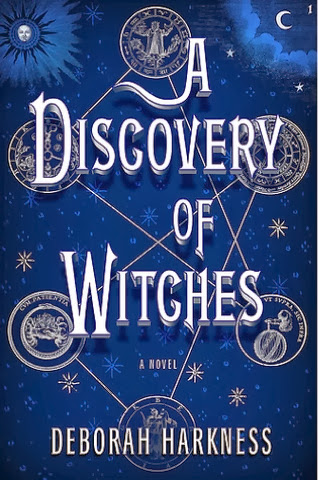
I have had my eye on A Discovery of Witches, by Deborah Harkness for a while. I saw it in Chapters just before my Church Campmeeting in July, but didn't get it because it didn't seem like a particularly good book for a church camp. Later, in August, I saw it while perusing the books at Value Village, and snagged it. It then set on my shelf of books I have yet to read until midway through September. I picked it up, and got about a third of the way through fairly quickly. Then it sat on my bedside table for a few weeks. It isn't that I lost interest and started to read something else, I just wasn't really reading much. 

This book came to work with me on nights, but never left my bag. I was either busy, or my eyes just couldn't focus on a book at 0230. This book also had the unfortunate disadvantage of coming to me just as I discovered the joys of Netflix. 

Then I started to read again. Over the course of October I read this book, and it's sequel, Shadow of Night. 

I found A Discovery of Witches to be a well written, and quite a well thought out book. It brings a large number of well known (and most likely a fair number of not so well known, who I didn't recognize) people into the story line which certainly adds a level of interest. I am not typically one for vampires, but having the immortal element is a nice way to show history to the reader

At first glance, this is a book about witches, vampires, and demons, but one doesn't have to look very hard in order to become enthralled in the politics in the natural world, the supernatural world, and the interactions between the two.

I also enjoyed the science/ scholarly aspect being brought into the story. The two main characters both work at a university studying and teaching, one alchemy, and the other genetics. This brings about a deeper aspect to the storyline than I expected from this book when I first picked it up.

This is book one of the All Souls Trilogy, two of which are out and I have read. I don't know when the third will be out, but I am looking forward to reading it. It is nice to have series, and a book to look forward to, instead of finding them all once they are all out. I think that the anticipation will make the third book even better.

Thursday, May 23, 2013

The Casual Vacancy


     I found the Casual Vacancy difficult to really get into. I bought it mostly because it was written by J.K. Rowling. I started it as soon as I bought it, then it sat on my side table for months. There are a lot of characters, and the book hops between perspectives.Somewhere between pages 50 and 100 I got interested. I got attached to some of the characters, disgusted with others, and even managed to be both disgusted and attached to some. I found it well written and interesting (although some of that interest may come from my current fascination with the British).
      The book is made up of many interwoven story lines which all take place within a small town in Britain. It deals with all of the typical/stereotypical small town dramas from death to elections to poverty to teenage rebellion. The book touched on so many topics that the discussion could be endless.
      One story line peaked my interest first, and was may favorite throughout. There is a social worker who is working while another is on a stress leave. This social worker is able to view a specific family through fresh eyes, and cares enough to try to make a difference. She starts to make a difference, and starts to gain a bit of this family's trust when the stress leave ends, and the other social worker comes back. This really struck a cord with me. I have seen many of my nursing coworkers become harsh and jaded. I have had patients complain, and even avoid using the call bell because they don't want the wrong person to come. They are hard to work with, and remind me of this on leave social worker.
     I ended up really enjoying this book. It got to the point when I couldn't put it down. The last 200 pages went by very quickly. While the book didn't end the way that I wanted it to, the tragic ending was fitting. Life doesn't always have the hoped for happy ending. This book shows how, if enough people drop the ball, there can be dire consequences. No one person is to blame, and everyone must live with the consequences. 


Sunday, May 5, 2013

The Cat's Table


The Cat's table, by Michael Ondaatje, was an entertaining read. Not that it was funny, but that the way that it was written pulled me into the story, as if someone was right there, almost reading it aloud. It is written as an autobiography, but it is actually fiction. For more than half of the book I thought that it was in fact the author writing about his own experiences. The story is a man, looking back on his childhood. He is remembering his experience traveling via large ship from his home is Sri Lanka to London, where his mother lives.

There are quite a few children's books which have some of the same basic themes, but this book is much more adult because of the fact that the narrator is an adult, and is able to decipher more. This book appealed to me in much the same way that movies like Dunstan Checks in, and books like Eloise, and From the mixed up files of Mrs. Basil E. Frankweiler did when I was younger. A kid is confined to a hotel (or mobile hotel in the form of a ship) for an extended period of time and gets into all sorts of mischief.

The main character is Mynah, an 11 years old boy from Sri Lanka.  He is traveling on his own, although he does have an older female cousin along who doesn't want much to do with him. Mynah is placed at the Cat's table (the one farthest from the Captain's table) in the dining room along with two other unaccompanied boys, and an odd assortment of adults. They get into just the shenanigans that one would expect of unsupervised, unaccompanied minors. They have a great time in the first class area before other people are up, and they see a surprising number of things while they hide in life rafts at night, including the discovery of a prisoner, and even a murder. These boys are also brought into many less that moral/legal situations by some of the adult around them (for example, sneaking into 1st class suites to aid in robbery).

It is in these more serious situations that the true plot comes out.I was certainly not expecting the twist in the last few chapters. Minor characters all of a sudden become major players in the plot, and the book went in a completely different direction than it had been before. All in all, it was a good read. It had me interested from the beginning through to the end, albeit for different reasons.

Saturday, February 23, 2013

The Perks of being a Wallflower.


The Perks of being a Wallflower by Stephen Chbosky was a fairly random pick. I had seen some previews for the movie, and decided to check out the book. It turns out that it has been a popular book for a fair number of years. There is even a whole section at the end with topics for book club discussions and such. The book covers many topics including: teenaged drinking, drug use, smoking, sexuality, and mental health, as well as a teenager's view on abuse, drinking, both suicide and attempted suicide, and death within his family. A person could talk or write for a very long time about this book and get into some deep discussions. I won't write that much because it really needs the back and forth of discussion.

The book is written in the form of letters. A troubled teenaged boy (Charlie) is writing to an unknown person (seemingly the reader). It runs over the course of one school year (and a summer). Charlie has an extremely difficult transition from middle-school into high-school. His only good friend committed suicide shortly at the end of the school year before. Charlie is also struggling with the death of his Aunt (about 9 years earlier) with whom he had an interesting/ distressing relationship.

Charlie is quite introverted, and socially awkward, and naive, yet he speaks what he thinks (sort of like Sheldon from The Big Bang Theory). In efforts to "participate in life" he becomes friends with a set of siblings, both of whom are a couple of years older than him. He gets accepted into their group of friends. With this group of friends, he goes through many stereotypical (or maybe just typical) teenage behaviors including exploring sexuality, drinking, and drugs.

This book really made me think about my high-school experience. While I was in it, I didn't think that my experience was out of the ordinary (for an introverted geek). When I entered collage I realized just how different my experience was.The thing about this book is that it captures the feelings of teenagers so well that you don't have to have experienced the situations to relate to them.

Monday, February 4, 2013

The Magicians


Every summer I go to my Church Campmeeting. This year I went to the bookstore in search of books which are OK to be seen reading amongst a large group of conservative Christians.  I came out with books, none of which fit the criteria. I took my old copy of Lord of the Rings to Campmeeting for the eightth year in a row, and set the new books others aside. It was September before I made it around to reading The Magicians by Lev Grossman.


I found The Magicians to be a interesting read. The main Character is collage aged, which seems to be a rarity, at least in the fantasy genre. It was refreshing to read about a character who was past the teenage angst stage, but also was not an adult, fully situated in their own life. It follows a young man who grew up reading a series of books which is clearly at least partly based on the Chronicles of Narnia. Instead of growing out of the series, he still reads it, and is slightly obsessed with them throughout his teenaged years. His experience could even be compared to reading a book. He goes from regular life, and is transported into a magical world (or three) where he makes friends, learns many skills, and goes on adventures. I connected with that, as I have also remained a fan of some of my favorite childhood series.

This book took many unexpected turns, and ended in a very different way than I thought that it would. It starts out with genius Quentin who is given, and takes, a chance to go to a magical university. While his school is different, much of his dorm and class life are relatable. The book deals with the post-grad "what now" period. The book them shifts gears and the characters use their education to take themselves to the world of Fillory which they had read about as children.

 While the characters don't share my same set of values and beliefs, and make many choices surrounding drugs and alcohol that I would not make, I find that these add to the story and to the characters personal growth. Quentin ponders his lifestyle decisions. and I think that the book accurately shows how a person's way of thinking changes as they get older and have more experience. 

This book was a great mix of Science fiction, and fantasy (mostly fantasy) two of my favorite genres. I was excited to find out that there is a sequel (which I have now read), but I didn't really have any idea where else the author could take the story. It was a complete story in itself.

Thursday, January 17, 2013

Reading

 As a child I struggled with reading. I remember reading in partners in grade one. We each had to read a simple book to the other person. I picked the same book as my partner, and had them read first, so that I would know the story. In grade two I started to be home-schooled. I remember sitting down with my mom to read chapters of Little house in the big woods,and the other books in the series. I enjoyed the story, but I dreaded the reading. I did enjoy the Berenstain Bear books (the little ones with four words on each page), not so much for content, but because I could read them by myself.

I remember when I realized that there were books out there that I could really enjoy reading and become absorbed into. In the mid-late 90s my brother got Star Wars on VHS, and in 1999 Episode came out. I loved this particular fandom/genre. I decorated my room to look like space, the games that I played were based on Star Wars, and I coveted the great toy lightsaber. This same brother grew out of a series of books, and gave me the Jedi Apprentice series.


These books were easy to read. They were short-ish, had simple language,  lots of action, and they had characters who I already knew and loved. I've read them over and over. They are still sitting on my bookshelf, warn edges, stains, and tape along the spines. These were my steppingstones into the world of reading.

Around the year 2000 the big bookstore Chapters opened in my home town, and as far as I remember, it was on one of our first trips there that my other brother discovered the Harry Potter books. Neither one of us were big readers, but we powered through the (then two) books quickly, and the third when it was released. I was so interested that I didn't even think twice about tackling the around 700 pages of book four, and the final book took me less than two days to read.


In grade eight, my English teacher (a long term sub) gave us "free reading" time. I didn't have a new book at the time, so I picked up my oldest brother's copy of The Lord of the Rings. For the next couple of months, those books barely left my side. I found it easy to be transported into Middle Earth, and when I finished it I had a "what now" moment.


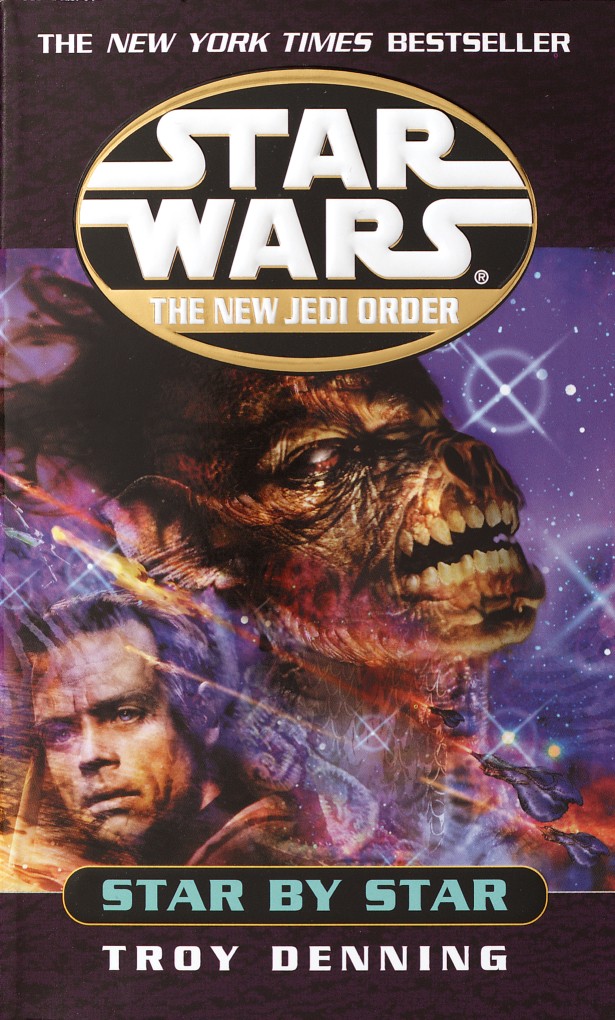
I went to Chapter in order to find another book for "free reading" time, and I found it. Right up front, on the new releases table, I saw it. Star Wars: Star by Star. A Star Wars book for grown-ups had been my dream. As I read it, it seemed a little out of context, but that didn't matter. It was Star Wars. After I finished, I wanted to know if there was more. I was shocked to see that there was a whole series. An entire bookcase in Chapters dedicated to Star Wars, and my book had been the latest release. My feelings of foolishness were overshadowed by the thought that I had YEARS of Star Wars books to read. It took me through high-school to read this series. I had a small group of equally geeky classmates who used my collection as a library. They are still adding onto the series, but my interests changed. University, and life got in the way, and I was spending less and less time reading. I read text books, and online, but not many tangible, solid, books.


This past summer I decided to get back to reading for enjoyment. I perused the book store, and have picked up a fair number of books. This blog is to reflect on what I am reading.