Monday, July 1, 2013

Mercy Train

Mercy Train is an interesting book which follows the stories of three generations of women, each at a pivotal point in their life. One is a young girl leaving everything that she knows, one and elderly woman facing death, and one a young woman facing life after becoming a mother. .

Timeline wise, the eldest of the main characters is a young girl, growing up in poverty on the streets of New York in the early 1900s. This is the character is the one which the title most literally refers.

Her daughter's story takes place when she,the daughter, is an elderly woman coming to the end of her battle with cancer.

The story of the third generation follows a new mother who is given a box of trinkets that had belonged  to her mother. As she goes through them, she tries to piece together the stories of her Mother and Grandmother.

I found this book to be an interesting and easy read. I have found myself enjoying historical fiction more than science fiction now, which surprises me. Looking back I see that I enjoyed reading historical fiction for school, but I always thought of it as school reading, not leisure reading. I don't necessarily think that my interests have changed, just that I take a less direct route the the science fictions section of the bookstore.

Saturday, June 22, 2013

A Map of Time


A Map of time by Feliz J. Palma is one of the only books which I have read which was not originally written in English. It was interesting, well written, and well thought out. I'm not sure what category this book would fit into. Somewhere between historical fiction, mystery, and fantasy. The book had a few story lines which were connected in ways which I was not expecting.

For much of the book I was expecting the narrator to become a character, who later wrote the events down, sort of like Bilbo in The Hobbit. The book is narrated by an all knowing, omnipresent point of view. This is not a perspective that I am used to. I'm not going to say that I don't like this perspective, but I prefer books written by a character's point of view.

The book includes many actual historical people, and I'm not sure which, if any of the events actually happened. I don't have enough knowledge of Victorian history to pick out fact from fiction. I know a bit about Jack the Ripper, H.G. Wells (and his book The Time Machine), and Dracula (although not much about the author). This is probably what the author was counting on. Inserting enough fact that readers will recognize names to make the whole storyline more believable. 


Thursday, May 23, 2013

The Casual Vacancy


     I found the Casual Vacancy difficult to really get into. I bought it mostly because it was written by J.K. Rowling. I started it as soon as I bought it, then it sat on my side table for months. There are a lot of characters, and the book hops between perspectives.Somewhere between pages 50 and 100 I got interested. I got attached to some of the characters, disgusted with others, and even managed to be both disgusted and attached to some. I found it well written and interesting (although some of that interest may come from my current fascination with the British).
      The book is made up of many interwoven story lines which all take place within a small town in Britain. It deals with all of the typical/stereotypical small town dramas from death to elections to poverty to teenage rebellion. The book touched on so many topics that the discussion could be endless.
      One story line peaked my interest first, and was may favorite throughout. There is a social worker who is working while another is on a stress leave. This social worker is able to view a specific family through fresh eyes, and cares enough to try to make a difference. She starts to make a difference, and starts to gain a bit of this family's trust when the stress leave ends, and the other social worker comes back. This really struck a cord with me. I have seen many of my nursing coworkers become harsh and jaded. I have had patients complain, and even avoid using the call bell because they don't want the wrong person to come. They are hard to work with, and remind me of this on leave social worker.
     I ended up really enjoying this book. It got to the point when I couldn't put it down. The last 200 pages went by very quickly. While the book didn't end the way that I wanted it to, the tragic ending was fitting. Life doesn't always have the hoped for happy ending. This book shows how, if enough people drop the ball, there can be dire consequences. No one person is to blame, and everyone must live with the consequences. 


Sunday, May 5, 2013

The Cat's Table


The Cat's table, by Michael Ondaatje, was an entertaining read. Not that it was funny, but that the way that it was written pulled me into the story, as if someone was right there, almost reading it aloud. It is written as an autobiography, but it is actually fiction. For more than half of the book I thought that it was in fact the author writing about his own experiences. The story is a man, looking back on his childhood. He is remembering his experience traveling via large ship from his home is Sri Lanka to London, where his mother lives.

There are quite a few children's books which have some of the same basic themes, but this book is much more adult because of the fact that the narrator is an adult, and is able to decipher more. This book appealed to me in much the same way that movies like Dunstan Checks in, and books like Eloise, and From the mixed up files of Mrs. Basil E. Frankweiler did when I was younger. A kid is confined to a hotel (or mobile hotel in the form of a ship) for an extended period of time and gets into all sorts of mischief.

The main character is Mynah, an 11 years old boy from Sri Lanka.  He is traveling on his own, although he does have an older female cousin along who doesn't want much to do with him. Mynah is placed at the Cat's table (the one farthest from the Captain's table) in the dining room along with two other unaccompanied boys, and an odd assortment of adults. They get into just the shenanigans that one would expect of unsupervised, unaccompanied minors. They have a great time in the first class area before other people are up, and they see a surprising number of things while they hide in life rafts at night, including the discovery of a prisoner, and even a murder. These boys are also brought into many less that moral/legal situations by some of the adult around them (for example, sneaking into 1st class suites to aid in robbery).

It is in these more serious situations that the true plot comes out.I was certainly not expecting the twist in the last few chapters. Minor characters all of a sudden become major players in the plot, and the book went in a completely different direction than it had been before. All in all, it was a good read. It had me interested from the beginning through to the end, albeit for different reasons.

Sunday, April 7, 2013

Tuesdays with Morrie


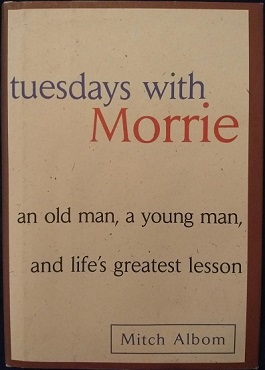
      I knew that I had watched the movie based on Tuesdays with Morrie in class sometime in university, but I wasn't sure that I had actually read the book. I saw it on the shelf and decided that it was one of those books that needed to be read. I realized, shortly after starting, that I had actually read the book before, but it was worth reading again.  It is one of those books that everyone needs to read.

     Tuesdays with Morrie, by Mitch Albom chronicles the story of the author as he reconnects with his old professor, and the two of them work together on what they call Morrie's last thesis. Mitch visits Morrie every Tuesday (for 12 or 13 weeks) as Morrie deteriorates from his ALS. They talk about basically all of the big things in life (family, forgiveness, society, life, death...). Morrie, once a physically vibrant man, continues to shine through his words. Mitch give Morrie purpose, and Morrie gives Mitch perspective.

 The whole book is packed. Nothing is written that doesn't mean something important.


“Be compassionate," Morrie whispered. And take responsibility for each other. If we only learned those lessons, this world would be so much better a place".

“Accept who you are; and revel in it".

 “The truth is, once you learn how to die, you learn how to live".


Thursday, March 14, 2013

The Diary of a Player


The Diary of a Player is Brad Paisley's autobiography. How he got where he is, and who helped him. I love country music, and Brad Paisley is a favorite of mine. I went to see him sing in Vancouver and it was awesome. I follow him on twitter, so I knew that it would be funny. I also enjoy learning about my favorite people, so this was an easy read.
 Brad Paisley seems to have remained humble in his stardom. A lot of the book is thanking people, and the stories behind why they are important. He has stories about just about everyone in country music, and a section of captioned pictures with many of them. He talks about Playing rock music in high school because that is what his peers wanted to hear, and he just wanted to be cool. He talks about how his music is influenced by all sorts of music, bluegrass, jazz, blues, rock, classic rock...
I don't think that it is the type of book that anyone who isn't a Brad Paisley fan would pick up to read. It talks about inspiration for his songs which is only interesting if you know the songs. I enjoyed hearing the stories behind the songs, and behind the artist. 

Monday, March 4, 2013

The Hobbit


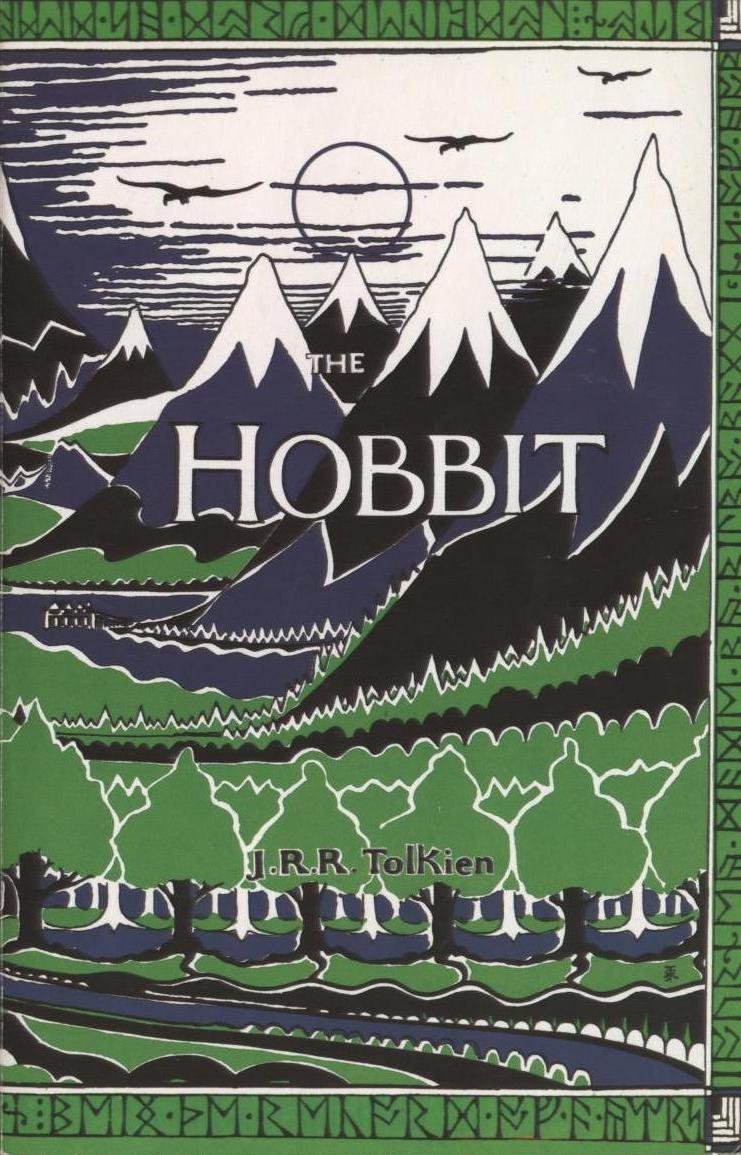
To say that it took me a long time to read The Hobbit would be putting it lightly. I originally started to read The Hobbit about ten years ago when I was in grade 8. We had silent reading time in English class. I finished The Lord of the Rings, and The Hobbit seemed like a good place to go from there. I was on chapter 13 when I discovered Star Wars books. Those distracted me from The Hobbit for the rest of High school, and then I never really got back into the mood. I have read The Lord of the Rings once a year for the past ten years, but I have never cracked open The Hobbit. When I went to see The first of movies this past December I decided that I needed to read the book, and finally finish it.

The Hobbit, by J.R.R. Tolkien, is the story of Bilbo Baggins, a Hobbit who is taken (somewhat unwillingly) on an adventure with Gandalf the wizard, and a company of Dwarves. They meet with all sorts of beings, some of whom help, and some of whom hinder the journey. The book is filled with the extensive description that Tolkien is famous for, which is wonderful in some places, but in others there is too much and the story seems to drag.

I can't help but compare it to The Lord of the Rings Which I love. They are set in the same world, with some of the same characters, but they are very different. In essence, The Lord of the Rings is a good versus evil story. The good guys must save the world from the evil guys. While it has many unexpected twists and turns, the reader knows the true purpose. The Hobbit, follows Bilbo who is helping the Dwarves reclaim their fortress and fortune. At first it seems like they are up against a dragon, but the story changes in the last few chapters throw the whole story into more of a gray area. The whole thing seemed to be driven by the greed of the Dwarves, and the people with whom they come in contact.

You probably can't tell from this, but I really did enjoy the book.  I can see how it is more of a children's book than Tolkien's other books. I'm glad to have read it, and will probably read it again before another ten years goes by.